


Antediluvian Civilizations
Introduction
'''Antediluvian civilizations''' are civilizations
believed to have existed before the Great flood of Noah. If the
fossil record is indeed the result of the
Biblical flood as described in the Bible, then it is somewhat expected for
evidence of antediluvian (pre-flood) civilizations to exist. It is assumed
by many that humans reached advanced stages of technological development
before the flood. Such presuppositions are usually based on the Biblical
genealogy, which states that ancient people lived to approximately 10
times our current life span. Also it is frequently mentioned that
Adam and Eve would likely possess higher than normal intelligence since
they were created as adults, with knowledge that subsequent humans obtain
from their parents. Another theory states that the
antediluvian race called the Nephilim was
superior to other humans in this respect.
All
accounts of the
Great flood from civilizations around the world indicate that there
were civilizations before the flood. However, as a result of the
destruction during the flood and the passage of time, the remaining
evidence is scanty. As a result of the flood, the earth was covered in
hundreds of feet of sediment, and very
little of the antediluvian horizon has been exposed. It is also
problematic that the scientific community is quick to dismiss any
artifacts that dispute their presupposed interpretation of the fossil
record. Nevertheless, any truly advanced civilization would have left
durable traces or constructions that would likely surface during
excavations or by erosion. Relatively insightful accounts can be drawn
from the Bible, apocrypha, and ancient Babylonian and Greek accounts of
antediluvian civilization. Lets examine whether it is really logical to
expect monuments such as the pyramids or better from the civilizations
that lived before the flood?
Longevity and the Written Word
Our technological development has only occurred as a result of an ability to store and access large quantities of preexisting data. The knowledge possessed by any one person or even a hundred is insignificant in comparison to the libraries of previous learning that have now been obtained, and without which advancement to our level would not have happened. These libraries of knowledge did not begin to develop until the written word was invented, and no archaeological evidence of even the most primitive forms of writing have been discovered earlier than ancient Babylon which followed the tower of Babel. Even several hundred years later, during the time of the Egyptians, only hieroglyphics were in use.
The development of symbolic language seemingly coincides with the decline in human longevity. Perhaps it was the shortened human lifespan that caused people to feel the need to write down their experiences or what had been learned. There had become a sense of urgency to preserve ones essence in some permanent form. It may have been this reduction in life expectancy more than anything else that induced the formation of the written word and ultimately the technological achievements we have made. Back when people lived to be 1000 years of age there was little need to archive knowledge. Most people would prefer to talk rather than write letters. If we could still talk to Galileo or Sir Isaac Newton, why would they bother to write down what they could more quickly say?
Implications of the Tower of Babel
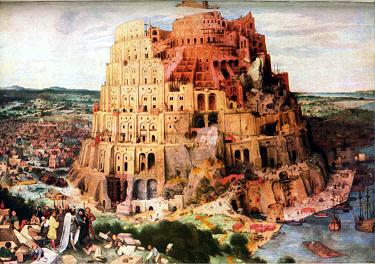 We can not dispute the existence of atypical
knowledge possessed by Adam and Eve, however,
we should also consider the tower of Babel curse as it relates
to human accomplishments to that date. Monumental constructions are
a great source of pride for humans. It was most likely this type of
technological development that God attempted to retard by creating the
language barriers at the tower of Babel.
We can not dispute the existence of atypical
knowledge possessed by Adam and Eve, however,
we should also consider the tower of Babel curse as it relates
to human accomplishments to that date. Monumental constructions are
a great source of pride for humans. It was most likely this type of
technological development that God attempted to retard by creating the
language barriers at the tower of Babel.
The Babel event suggests that the tower was the first major monument that mankind had ever built. It was the first construction that had no purpose but to be a monument to human achievement. The tower was not a particularly important technological development. It was built out of bricks, and was therefore incomparable to even the limestone pyramids. In comparison to our modern building it was hardly more than a mud mound. Many better monuments would be built afterwards, but given God's reaction, it is logical to propose that nothing like it had been built prior to the flood.
Why do Men Construct Buildings?
Most people are puzzled why antediluvian buildings have not been found. After all the construction of cities is clearly referred to in the Bible.
Genesis 4:17 And Cain knew his wife; and she conceived, and bare Enoch: and he builded a city, and called the name of the city, after the name of his son, Enoch.
The construction of dwelling space is driven almost exclusively by our need to shelter ourselves from the weather. Prior to the flood, the atmosphere is thought to have been much more stable than it is today, providing an almost globally uniform temperature. It is believed that there were no dramatic seasonal temperature fluctuations, or even significant differences in temperature between the polar and equatorial regions. This is evident by the discovery of fossilized ferns and amphibians on Antarctica. It is also believed that it had not rained prior to the flood, but the earth was instead watered by free-flowing springs and mist. Given that this type of perfect environment likely existed before the flood, it might be better to ask why people would build houses if they needed no shelter from the elements? One answer would be: to protect ourselves from wild animals and other humans. The earth was a violent place before the flood.
Genesis 6:5 And God saw that the wickedness of man was great in the earth, and that every imagination of the thoughts of his heart was only evil continually.
Nevertheless, any constructions during this period were likely made of wood or dried mud. These materials are simply not expected to stand up well under catastrophic flood conditions. Even baked clay will dissolve if saturated for prolonged periods. This type of material has historically only been used to extremely arid regions for this reason. If they did not need to build shelters from the weather, and had never built a monument before the tower of Babel, what would we expect to find? Perhaps some protective fencing or walls might still remain if they could have survived a raging onslaught greater than the dam breech that hollowed-out the Grand Canyon. There may also be some clothing made of animal skins or stone tools, but no reason to expect anything more significant. Given the presuppositions of evolutionists and the certainty of their belief, any trace evidence of a antediluvian civilizations would likely be dismissed outright and we would never hear about it.
Additional Resource
- Creationist Perspectives on Antediluvian Civilizations
- Antediluvian Artifacts
- Evidence of Dinosaur & Human Cohabitation
- Evidence of Humans in the Geological Column
- Who Were the Nephilim?
- Genesis 6-8 The Flood of Noah
- Noah's Ark Homepage
Creationist Perspectives on Antediluvian (Pre-flood) Civilizations
- Ancient Atomic Knowledge? by Ooparts & Ancient High Technology - Evidence of Noah's Flood
- Ancient civilizations and modern man by David Criswell. Creation Magazine Vol. 17 Issue 2
- Currents of conspiracy
- History, Pre-History, Archaeology, and Evolution News Archive
- Forbidden Archeology by Michael A. Cremo @ Amazon.com
- Fossilized Human Finger by
- Preflood Traditions The Weakness of John Pilkey's Origin of the Nations by Roy L. Hales
- Signs of Ancient City off Cuba 2/01/01
- The mystery of ancient man by Steve Cardno. Creation Magazine Vol. 20 Issue 2
- The Riddle of the Ooparts by Charles Scott Kimball
- Underwater Cities; Noah's Flood Proof? by Ooparts & Ancient High Technology - Evidence of Noah's Flood
Antediluvian Artifacts
- Bell in Coal by Genesis Park
- Cretaceous Hammer by Genesis Park
- Forbidden Archaeology (book review) by Genesis Park
- Odd Things in Wrong Places from Time Upside Down by Erich von Fange
- Pot Found in Coal by Creation Truth Ministries
- Remains in Coal and Rock by Pathlights
- The Iron Cup in Coal by Creation Evidences Museum

Biblical Archaeology: Creation Books and Videos
|
Regular price: $140.92
Sale price: $105.69
|
$15.29
|
$26.95
|
$13.45
|
|
$15.29
|
$8.95
|
$12.59
|
$7.95
|
|
$11.95
|
$11.95
|
$22.45
|
$8.95
|
|
$13.00
|
$12.00
|
$6.29
|
$26.99
|
|
$29.74
|
$11.70
|